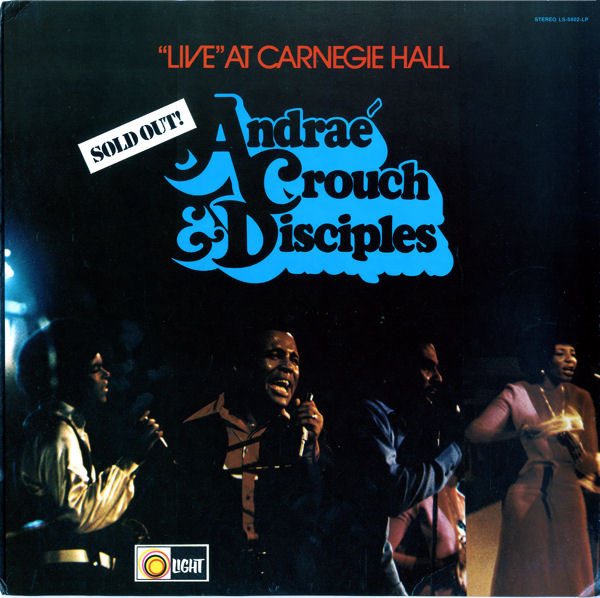
"LIVE" AT CARNEGIE HALL by Andrae Crouch & the Disciples Light Records • LS 5602
"Ladies and gentlemen, Carnegie Hall will never again be the same..."
You can say that again.
The album actually begins with someone leading the audience in the "Jesus cheer" that was popular in the early 70s. The announcer with the deep baritone voice delivered the pronouncement above, and the crowd roared its approval.
"And it's with Jesus' joy I present to you...Andrae Crouch & the Disciples!"
Usually, live albums sort of have a short shelf life. They're a bit like comedy albums in that regard - enjoyable and interesting at first, but less so with repeated listening. There are exceptions. And this is one of them.
Now, be sure to read all the way through this post because Andrae's drummer, Bill Maxwell, shares some information that may shock you. I know it did me. But first, let's dig into why this live album is still so beloved all these decades later.
I had a chance to talk with Maxwell and I asked him about the popularity of "Live" at Carnegie Hall. "Carnegie Hall was more indicative of what Andrae Crouch & the Disciples were, live, at that time," he said. "And his previous records were nothing like this one. You know, Keep On Singin'was kind of a very white-bread, up-with-people kind of record. And on Soulfully, he just hired a bunch of Motown arrangers and it was like an Andrae version of a Motown record - not really indicative of his music. But this was really him. And it was the first time that sound had been released. And things kind of broke for us at that point."
When Bill Maxwell says "that sound," he's not just talking about a style of music. He's talking about the anointing of the Holy Spirit...something Andrae called "having church." There was a focus on praising God and, yes, there was an anointing on Andrae's live performances. The Holy Spirit ministered powerfully through AC&D. I don't mind telling you that it happened again to me just this morning. I was listening to this album on my way to work for the first time in quite a while, and at a certain point the presence of the Lord was so strong in my car that I began to weep. I was enjoying it so much...but then I said to myself, "You've got to get yourself together, man! You've got to go into the office soon and everybody's going to wonder what's going on..."
I shared this quote in my post about Live in London, but it's worth revisiting:
"Really, with Andrae, my favorite thing was the way he led worship when the Holy Spirit would show up. That's what separated Andrae from just being a band. There was an anointing on it. God would just show up. It happened for a long time, and when it was happening, we knew it. Because it was like, you're on stage and you could feel that something was happening. That's what made Andrae special. It was a gift that was on him." -Bill Maxwell
Andrae's former road and stage manager Steve Giglio said, "I can remember Andrae being on stage for three hours, and the power of the Holy Spirit was non-stop."
"This is not a concert tonight; we're havin' church!"
-Andrae
Most people have heard the story of how the Lord supernaturally granted Andrae the ability to play the piano. And then Crouch has also told about his Holy Spirit baptism in two different songs - Satisfied and Take A Little Time. But he went into a great degree of detail about that experience in his autobiography Through It All, written with Nina Ball and published in 1974. For more on that, go back and read our post on the album Soulfully.
Frankly, all this Holy Spirit stuff was new to some in Crouch's audiences. There's a reason he spent time joking about "the First Church of the Frigidaire." There was a reason that he said to the crowd, "If you come from the other side of the tracks, or if you know what goes on on the other side of the tracks..."
Up until "Live" at Carnegie Hall, Andrae, although himself a product of the Church of God in Christ denomination - a primarily black denomination that was open to the gifts of the Holy Spirit - for whatever reason, played to mostly white audiences. Sometimes it would be a bunch of Jesus Movement hippies in Southern California. Such was the case the first time Alex MacDougall saw Andrae live. "A 1970 Jesus Music concert was loosely organized on a Huntington Beach high school football field, and the groups all shared a small stage," MacDougall recalled for a story in Worship Musician magazine in February of 2019. "The audience was white, and the Jesus Music played on stage very much resembled the singer/songwriter, country-rock sounds of the day. However, Andrae sounded nothing like that at all! He performed with such exuberance, joy, and confidence that it was contagious."
So Andrae fit in just fine with the Jesus People...but often he would find himself singing to crowds of a more conservative nature. A Billy Graham Crusade, Robert Schuller's Crystal Cathedral, TBN...places like that. "Our audience was 90% white," Maxwell said. "Andrae would do somewhat relatable and conservative songs for the first part of every concert, and then when he felt the audience was comfortable with him, he'd switch into a black gospel expression." Oftentimes, this would be the first time that these audiences had ever been exposed to such a concert.
Sure enough, Bill Maxwell said that the Carnegie Hall crowd was essentially an all-white audience. "But when everyone heard the finished product, it was the first album Andrae had done that got black people listening. I joined Andrae in the summer of 1972. Very few black people embraced his music at all, but after Carnegie Hall they did because there was an excitement to it, and that Pentecostal environment." Maxwell said that after "Live" at Carnegie Hall had been out a little while, the group played a concert in Detroit. There was a guy that attended that concert by the name of Marvin Winans. "Marvin came to the concert expecting a segregated hall," Maxwell said. "He arrived and went up to the balcony to sit where he thought he was supposed to sit, but instead found the balcony occupied by both blacks and whites. And this was in the mid-70s!" It was a time when both race and music caused deep divisions not just in the Church but in society at large. Maxwell said that Marvin Winans was surprised to find not only an integrated audience, but also an integrated band on stage. "Marvin said it was one of the most liberating moments of his life," Bill remembers. "I don't know anyone else besides Andrae that broke down those barriers." By the way, The Winans would record their very own Live at Carnegie Hall album in 1988.
In 1977, Bill Maxwell was producing an album for Keith Green and ran into a bit of a time constraint. So Alex MacDougall was given the opportunity to hit the road with the Disciples as a fill-in drummer. "I was amazed at everyone, every race and every age group coming together as one during those concerts," MacDougall recalls.
The album is full of hits: I Don't Know Why, I Didn't Think It Could Be, You Don't Know What You're Missing, Jesus is the Answer, It Won't Be Long. There's a rowdy rendition of Can't Nobody Do Me Like Jesus and Bili Thedford gives a hair-raising performance on the Dottie Rambo classic, He Looked Beyond My Fault. And Andrae drew on his abilities as a worship leader when he led the audience in that 70s worship chorus that had only one word in the lyrics...Alleluia. Or Hallelujah as Andrae called it. (I used to joke that Jerry Sinclair probably stayed up all night writing that one.)
You may notice that I'm not dedicating much space to reprinting song lyrics...because, to be honest, most of them were very simple expressions... Jesus is the answer | for the world today | Above Him there's no other | Jesus is the way...It won't be long | 'til we'll be leavin' here | It won't be long | we'll be going Home...I don't know why Jesus loved me | I don't know why He cared | I don't know why He sacrificed His life | Oh but I'm glad, so glad He did...
Maybe the simplicity was the secret. Don't misunderstand - Andrae was a spectacularly successful songwriter. But his songs took root in our hearts not because of lyrical depth and complexity. Again, I believe it was because of the anointing of the Holy Spirit.
Bill Maxwell
Bill Maxwell has said that Andrae would often begin a song with the chorus (which, of course, is not typically done; you would normally start a song with the first verse). "He would start with the chorus and then repeat it once or twice before ever going to the verse," Maxwell said. "That way, the song imprinted in everyone's mind by the time the verse was sung. We used that template a lot during those years." He did it with Jesus is the Answer, It Won't Be Long, Soon and Very Soon, Take Me Back, and many others.
Historian Mark Allan Powell says "Live" at Carnegie Hall was the first live album to come out of the Jesus Movement and was one of the two or three best (with To The Brideby Barry McGuire and the 2nd Chapter of Acts being its biggest competition). Powell writes in his Encyclopedia of Contemporary Christian Music that this album "offers at least a glimpse of what (besides great songs) made Andrae Crouch & the Disciples an international phenomenon: electrifying live performances. The fact is - as a few non-Christian rock fans discovered - in the early 70s, Crouch and company were on a short list with The Who and the Rolling Stones for providing one of the best concert experiences to be had. Andrae called it 'having church,' and you couldn't get out without hearing a lot of preaching-to-the-beat music." In fact, there's an entire track on this album that's simply titled Andrae Preaching. Not to belabor the point, but this record seriously served as an introduction to "black church" for so many white Christians in America and even around the world. Powell says the album also received a good bit of crossover attention in secular R&B/pop radio.
"I want the ushers just to close the doors; we're gonna be here for a few more minutes."
-Andrae
In the book Through It All, Crouch said, "The hardest thing about always being on the go is leaving your home, your local community, the relatives and friends you see every day to suddenly open up your life to everybody all over the world. You become involved with more and more people and there is so much heartache it can break you. I had to learn to rely totally on the Lord. Totally."
The one and only time I ever saw Andrae Crouch & the Disciples live was under a large pavilion at Six Flags Over Georgia in Atlanta, around 1976. The Pat Terry Group opened the concert. I was young and it was a long time ago, so I'm afraid I don't remember many details from that event. I do remember Pat, Sonny and Randy sitting on their stools, playing and singing. And I just remember the buzz...the overall excitement and anticipation of what seemed to me like a very large crowd, gathered to see and hear Andrae and his group.
"Sometimes when we arrive to do a concert it seems to us as if the people believe that since they paid their money, now we are to pour out to them," Andrae told Nina Ball in his 1974 autobiography. "That attitude becomes so demanding that sometimes I ask them to pray for us before we sing. But once they are in the Spirit with us, they minister to us and us to them and all of us to the Lord. Then the body is functioning as a body, in unison, and there is no way a non-Christian can leave untouched. We can always sense if people have come to be fed, entertained, or just to ridicule us and ask, 'Who are these people?' We don't profess to be anybody or anything but sinners saved by the grace of God whom He has chosen to do a work."
Sandra Crouch sang a memorable solo on Jesus Is The Answer
Here's a funny life-on-the-road story from the book: "I remember one summer when the Disciples sang in a park in Nebraska. Was it ever hot! Many people were wearing shorts, muumuus, and Levi's, but there were a number of church people in black suits, hats and ties, who were sitting on blankets. Sandra had never worn anything but a dress to sing in up until that time, but I had told her to buy some culottes to wear because we would be singing on the back of a flatbed truck and climbing up and down. After the concert, one of the brothers wearing black suits came up to Sandra. 'You all are an anointed group but, sistah, you got to come out of them britches!' Sandra put her hands on her hips, looked at him and asked, 'Right here?' I ended that conversation with, 'God bless you, good to have you here today.'"
Andrae's parents: Rev. Benjamin & Catherine Crouch
Andrae said he never forgot the words of his pastor father, spoken when he first started touring: "Son, God is going to use you. As you travel, your name may be in lights but if you don't care about people, if you get on stage and don't feel for those people, don't have a burden, a compassion to win them at any cost, then is the time to come home."
Andrae's crisp and energetic piano playing certainly stands out on this album. I was a kid just learning to play when this record came out, and I was influenced by Andrae's playing probably more than anyone else. I'm nowhere near in his league, but I can remember imitating his fills when I was in my early teens...and I still do.
The liner notes on the back of the album say that 1,500 people jammed the Baptist church across the street because they couldn't get in. It says, "The Disciples played in the church first and then ran back to the famed Carnegie Hall where thousands of people were anxiously waiting to praise Jesus." It goes on to make a point that "this album is not a slick or watered-down album. It is rough and honest." Yeah, to be blunt, despite the fact that this record is a cultural touchstone for the Jesus Movement and despite the anointing that's obviously on it...well, I'm just going to say it. There's some sloppiness on this album where it just doesn't sound like the rhythm section is firing on all cylinders.
Turns out there's a good explanation for that.
Bill Maxwell
Here's the part that's going to blow your mind. You might want to sit down. Or at least grab something to steady yourself.
Telephone interview | June 2017
Bill Maxwell: "Live" at Carnegie Hall was recorded in February or March of 1972 and what most people don't know, and I don't mind saying, is that I wasn't there.
Me: Wait...what?! You're in the credits. On the album cover. You played drums, right?
Bill: The whole album was overdubbed.
Me: You're kidding.
Bill: Nope. They recorded the concert and Andrae wasn't happy with his band. He had a band of amateur musicians. And when everyone heard the finished product...
Me: So...wait...what are you saying?
Bill: Andrae had the tapes and he told the record company that he didn't like it. He didn't like the band, didn't like the way the thing sounded. The only thing he liked was the audience and his own performance. And so he said he'd like to try to work on it and fix things. And the record company was just sure that he was going to mess it up. And they wouldn't give him the masters, but they made him a copy of the masters.
As you might imagine, as I'm hearing Bill say these things over the phone, my mind is racing. I mean, it's common for a live album to have an overdub here, maybe fix a little something over there...but this was taking overdubs to a whole other level. Bill continued, and got a little technical with his explanation of how Andrae saved the Carnegie Hall album.
Bill: The piano was recorded with a pickup, which is not a microphone, so it just picked up the sound of the strings in close proximity and it didn't have much leaking. So you didn't hear drums or vocals in it, and his vocal mic was very clean, so we essentially replaced everything. Hadley Hockensmith replaced the bass and the guitars. I replaced the drums - even though sometimes the drummer messed up and the beat got kind of flubbed around, I just had to go with it and try to match it. Harlan Rogers overdubbed the organ and then they replaced all the background vocals.
Me: But what about the crowd noise?
Bill: The crowd was the crowd. Now, he couldn't bring it up too much in the mix if the band was in it, so it had to be where it wouldn't expose the fact that it was a different band playing. But all of those responses, it was all from that crowd. That was the main thing - the only thing Andrae overdubbed was "Good night and God bless you!" That was done after the fact and that applause was brought in there at the end, obviously. But pretty much, that's what the crowd did. They were wild and loud. That was them.
Wow. Unbelievable. So I guess maybe that's why the word "Live" is in quote marks on the album cover? I had never noticed that before.
Just to be clear, for the record..."So you, Fletch Wiley, Hadley Hockensmith and Harlan Rogers, none of you were actually at the concert?"
Bill smiled and said, "No. But people swear they saw me there."
Fun Facts:
• There have been at least 17 albums that have been titled Live at Carnegie Hall, including records by Bob Dylan, Jethro Tull, Liza Minelli, Stevie Ray Vaughn, comic Ray Romano and Billy Joel.
• There have been at least 92 albums, total, recorded at the prestigious theatre in New York City. They include projects by Benny Goodman, Frank Zappa, Buck Owens, Dizzy Gillespie, The Who, Chicago, Groucho Marx, Glenn Miller, Greg Allman, Miles Davis, Frank Sinatra, Tony Bennett, and Paul Simon (whose album Rhymin' Simon includes Jessy Dixon singing (and some woman totally over-singing) Andrae's song, Jesus is the Answer).
THE SKY IS FALLING by Randy Stonehill (Recorded in 1977 | released in 1980) Solid Rock | SRA 2005
"Where Welcome to Paradise was sweet and gentle, emotionally, The Sky is Falling was a walk down a broken road toward the end of the world."
OK, maybe. But I've rarely heard a walk down a broken road sound half as good or be nearly as much fun as this one.
That quote above was penned by the album's producer, one Larry Norman, in the liner notes for the criminally-late CD reissue of The Sky is Falling, which wasn't made available for purchase until 1994. We suffered without our digital copies of The Sky is Falling for about a decade and a half. Some fans wailed and complained while others of us suffered in silence. But suffered we did. And it was so worth the wait.
Waiting fourteen years for a CD is pretty extreme. Come to think of it, there was another time that I went to extreme measures in order to get my Stonehill fix. I caught wind that Randy was going to be giving a live concert at an Assembly of God church in my hometown on a Sunday night in April of 2014. Well, I certainly wasn't going to let this opportunity pass me by. Even though by this time I had seen Randy Stonehill at a college and at two different coffeehouses in Columbia, SC; twice at the Cornerstone Festival (including a turn as an "Honorary Eddie" while singing with the Swirling Eddies in Grayslake, IL); and twice at my then-home church in Greenville, SC (flying solo on Sunday morning and then sharing the stage with the great Bob Bennett later that night). But still...if he's anywhere near, you don't pass up that opportunity, am I right?
Bob Bennett and Randy Stonehill at College Park Worship Center | Greenville, SC June 24, 2012
There was only one problem. I didn't have a set of wheels that day. I think we had one car in the shop and my wife had gone to her mother's (of course) for a little Sunday afternoon visit. Those visits always dragged on forever...and she wasn't answering her cell phone. I tried other friends and family members and couldn't get anyone to answer. So I left a voice message on my wife's phone and then did what any half-maniacal Stonehill fan would've done...I struck out walking.
Ten miles.
Along a busy (i.e. dangerous) 2-lane highway with no sidewalk and no shoulder for much of the journey.
I had trekked about 4 miles or so when my wife, who had finally heard my voice mail, pulled up and motioned for me to get in the car. Keep in mind that I was a grown man in his fifties when this ridiculousness transpired. Hey, I had to see Uncle Rand one more time. Whatever it took.
A Randy Stonehill concert is an experience like no other. Much has been made over the years of his ability to have you laughing one minute and crying the next (which is absolutely true, by the way). In preparation for this blog post I reached out to the prolific and inestimable Mr. Alex MacDougall (who played drums and percussion on The Sky is Falling). "Randy had the very rare ability to enter a stage and completely captivate an audience," MacDougall said. "That's a very rare gift. He was a high energy performer and deeply talented. I toured North America and did the U.K. Greenbelt Festival with him during the late '70s, as well as an early 'Amos 'n Randy' U.S. run. He and I would always go out front stage to talk and pray with concertgoers following an event."
For his part, Randy told author Steve Rabey in 1986 that live concerts were a wonderful opportunity to actually look into the faces of the audience - the people that he wrote and recorded for. "You're on stage and you try to give your heart, try to give something real," Stonehill said in the book The Heart of Rock and Roll. "I try to save up all my energy, jump in, and give 105 percent. I love what I do, and I feel like if I'm not losing a lung or some vital organ for the audience I'm cheating them." The man's energy and productivity over all these years has been astounding. As I write this in 2021, he continues to tour. He's never stopped. Oh - and if you'd like to read all about that concert that I tried to walk to...click here.
Most of us were introduced to Randy Stonehill via 1976's Welcome to Paradise, effectively his debut album and an absolute masterpiece. I know that Born Twice came before, but Welcome to Paradise was his first nationally-distributed album, his first "real" album...and the one that most folks heard first. [It will surprise no one that WTP will no doubt turn up later on this list.] Welcome to Paradise set a very high bar and raised expectations for a sophomore release...a sophomore release that would surely come a year later, right, because you always strike while the iron's hot, right? But '77 came and went with no album. Then 1978. Then '79. Still no record. What in the Sam Hill heck was goin' on here?
With The Sky is Falling being released on Solid Rock Records, it naturally came complete with liner notes and an album sleeve loaded down with photos, interviews, an album review, etc. (back in the day, a Solid Rock gatefold album cover and packaging was a treat for the eyes almost as much as the album was for the ears). So in an interview that was included as part of the package, Randy was asked by an anonymous interviewer (with long, blonde hair, perhaps?), "Is it true that you wanted to release the album in 1977?" To which he responded, "We all did. But there were problems, so we didn't." And that was that. Stonehill dealt with the 3-year delay by deftly swatting away the query as effectively as the proverbial politician who's asked, "Senator, is it true that you finally stopped beating your wife?" Years later, we would learn that the delays of albums like Stonehill's The Sky is Falling and Horrendous Disc by Daniel Amos were really inexcusable and the source of great consternation within the small, tight-knit artistic enclave known as Solid Rock. I asked Alex MacDougall if he knew anything about the delay. "Some of TSIF rough mixes and scratch vocals were shared with me in late '77 or '78," he said. "I don't know about the reasons for the delay of the release, but in retrospect, I think that some of the Solid Rock artists' careers, while 'managed' by Larry Norman, were also subordinate to his own release schedule, attention, ego and energies." Enough said.
So this album finally saw the light of day - or at least the record bins of Christian bookstores - in 1980. But since it was recorded in 1977, we've made an executive decision to include it on our 1970s blog and not on our 1980s blog. Musically, it's much more of a 70s album anyway.
Billboard's Barry Alfonso wrote that TSIF was unusually well-produced for a 70s-era Christian market album. Well, sure. It was produced by Larry Norman and it was on Solid Rock Records. Goes without saying. For all of his faults/contradictions/eccentricities, Mr. Norman flat-out knew his way around a recording studio.
Randy Stonehill and Larry Norman
Christian teenagers (like me) in the mid-70s considered Randy and Larry to be our dynamic duo, a "bromance" made in rock and roll heaven. Due to a series of complications that involved broken promises, bad business dealings and some pretty bizarre relationship drama with the weaker sex, they would sadly become "frenemies" and nurse a grudge in sometimes very public, albeit passive aggressive ways throughout the 80s and 90s. Thankfully, the two found a way to bury the hatchet and make at least some semblance of peace before Norman's homegoing in 2008. I'm not going to write or report or speculate on any of the back-and-forth about marriages or songwriting royalties or professional jealousies, so if you were hoping for that, turn away now. You can see/hear/read all of that at any number of other places. I will say this, though: my brother Drue and I had the privilege of taking Randy and his wife Leslie to lunch in 2013 following Randy's concert at our church. I will only tell you that when the conversation turned to Larry, the pain on Randy's face and in his voice was palpable, a full five years after Norman's death. And yet God saw fit to use the unlikely pairing of those two men to reach so many people. We will never know this side of eternity the spiritual fruit that was produced by the partnership of Larry Norman and Randy Stonehill.
In his Encyclopedia of Contemporary Christian Music, historian Mark Allan Powell claims that The Sky is Falling is a more diverse but more inconsistent album than Welcome to Paradise. That's fair, although I wouldn't use the word inconsistent. I would say that TSIF is a broader album in terms of both musical style and lyrical themes. WTP was more of a concept album that stayed in its lane, while TSIF jumped around a bit, giving us a preview of what Stonehill's recorded output was going to sound like in the future.
Powell has written that Stonehill's material tends to fit into three broad categories: 1. Acoustic pop ballads that offer incisive reflection on the human condition 2. Faith anthems with a heartland rock/rockabilly sound to them 3. Uncle Rand songs - wacky, humorous ditties that satirize pop culture
All three categories were on display on The Sky is Falling. In the Billboard Guide to Contemporary Christian Music, Barry Alfonso said TSIF "swings between emotional extremes, brooding on mortality one minute and spoofing pop culture the next." Yes. That's called a Randy Stonehill album. Yes, please.
TSIF begins with a gritty rock song that Stonehill claims to have written in his sleep. If that's true, he writes better alseep than most people do wide awake. In an interview included with the album, Randy says that just before he woke up one night, he could hear himself singing this song, and could even "see" his hands on the neck of his guitar. When he awakened, he grabbed a guitar and tried to remember the song before it faded. He could remember the melody and chords, and enough of the lyrics to have a general sense of what the song was about. He says it was all in a subconscious code, like a dream language. The work of the Holy Spirit, perhaps?
That song turned out to be One True Love. It's a rollicking way to kick off the album and benefits from some highly recognizable vocal harmonies by Larry Norman. There's also a barn-burner of a slide guitar solo by the late, great Jon Linn. Alex MacDougall said, "Randy always introduced the band in our live shows and he would often look at Jon and say, 'I love you. I hate you.' That's because Jon was extraordinary. He was like an animal when he played a solo."
One True Love is basically a song that serves as a hip, rock and roll tract to the unsaved. The lyrics are a bit on the confrontational side for Randy Stonehill, some might even say it's a tad preachy:
You might spin till you're dizzy Just trying to stay alive But you're so busy hustling You never arrive
Don't try being a loner 'Cause that's your first mistake Go on once and admit that You need a break Well, we all need a break
You need one true love Someone who's always there Don't try to act like you don't care
You need one true love Go on and get it straight You're only losing while you wait
You need one true love Then you can really live You only get back what you give
Next is the hauntingly beautiful Through the Glass Darkly. I'm reminded that this record was made in the 70s when I see that this tune clocks in at just under six minutes...and has a 46-second intro. No regard for radio airplay...because there wasn't any to speak of! Great songs like this one were allowed to stretch out and breathe.
Critic Mark Allan Powell says that Stonehill tries his hand at social commentary on this track, "offering a backward glance at the failed agenda of the Kennedy era and the hippie movement." If you just read the lyrics, this song can come across as somewhat hopeless and more than a little depressing. Randy said the song was about people looking for answers and finding none. You might say it's a little like the book of Ecclesiastes set to music... It seems like all our dreams turn into tragedies / and I wonder if we'll learn from the mistakes we've made / Now I'm waiting at the bus stop for the bus to arrive / And I know there must be more to life than staying alive / Well, I don't know where I'm going when I climb in / But it can't be any emptier than where I've been...
The "guru"...then and now?
Verse one talks about a young man that was put forward as a god. Larry and Randy heard that the 15-year old Guru Maharaj Ji (who was actually more like 22, but was advertised as 15) was holding forth at Alexander Palace in London. He was billed as The Great Master. Randy Stonehill recalls being utterly disappointed in the guy's "plastic divinity," as Randy put it. (By the way, his real name is Prem Pal Singh Rawat, he's still alive, and you can read all about him and the stir he created in the early 70s at his Wikipedia page.
The 2nd verse takes on overzealous Christians who were long on dogma and short on love. And the 3rd verse recounts a brush with Jimi Hendrix on the night before his overdose. I'm pretty sure Randy was taking some creative license here to simply point out that even famous rock stars were lost and alone at the end of the day. Randy made the point in the liner notes that Hendrix, Clapton, Pete Townsend, and Elton John were all worshiped as though they were gods...but they had no answers. Even with six minutes to fill, Stonehill resists the urge to spell out the Answer; he's content to simply drive home the idea in this track that man has made a mess of things. (Although, it seems to my ears that the background singers are saying something like He loves you, baby, ooh la la...He loves you, baby, ooh la la... at the very end of the song. But it's somewhat buried in the mix.)
It really is one of the most memorable songs on the album. Somber. Thought-provoking. Disturbing. Beautiful.
Incidentally, there's a very nice groove that takes place at about the 2:33 mark and again at 4:52 of Through the Glass Darkly. It was clear that these singers and musicians knew one another well and were a very strong unit when playing together.
The emptiness of stardom is a theme that continued on the muscular rock anthem Teen King. This line always made me laugh:
Now that you're a star all the chicks in the bar know what you're drinking
Stonehill let it be known that this was inspired by The Eagles' Glen Frey. If there was any doubt, consider the following lyric:
Hey, you were right when you said it's hard to tell the night time from the day But you're ending up a desperado anyway
Randy was quite direct and uncharacteristically blunt in an interview printed on the album's liner notes. "I did want to write a kind of warning of getting swept away by false images of self-importance or living in a fantasy world," he said. "I think the Eagles have been very eloquent in describing human phoniness and pointing out the dilemmas and heartaches of the human condition. They seem very clever at pointing out what is wrong...but they haven't been giving many answers. Which is okay. Maybe they realize they don't have any answers."
"When you're a popular rock star, your fans know all your hits and your true fans even know the B-sides of your singles," offered Larry Norman. "But if you're really famous, people who have never heard any of your music or watched you on The Midnight Special will know what kind of car you drive and who you're living with thanks to the photographers and journalists from People magazine. Teen King is a somewhat snide look at fame and the pressures of rock and roll living."
In the record's liner notes, Randy extends a special thanks "to Glenn and Don stuck in the fast lane...may you find the narrow path."
Next up, strap yourselves in for a wild and wacky take-down of too much television. First he destroyed cigarette smoking in the song Lung Cancer on Welcome to Paradise. This time, Randy places television squarely in the cross-hairs and effectively rips TV a new one, you might say.
The Great American Cure, a rambunctious rocker, is another memorable moment from TSIF. Jon Linn is absolutely on fire with his guitar work here. MacDougall's percussion and Norman's harmonica also add a lot to the track.
Oddly, The Great American Cure, even though it's one of the hardest-rocking songs on the album, sort of allows Randy Stonehill to find common ground with legalistic, fundamentalist preachers of the time. Because they were always warning people about "wasting too much time with the boob tube" and "watching them filthy soap operas on that old one-eyed devil box"...you know, stuff like that. Randy's admonition was much more cleverly phrased:
I went to the doctor all nervous and crazy I told him the way things were He smiled quite nicely and without thinking twice he said Just try the great American cure
Put your brain in neutral Turn on the television set Kick off your shoes and don't worry They haven't cut the power off yet
So I went on home and I tried his prescription I watched till my eyeballs dried The good guys are winning, I can't keep from grinning And I dream about the TV Guide
So if you feel faint when you pick up the paper If politics make you ill If people upset you and high prices get you And you're just too broke to purchase a thrill
Put your brain in neutral Turn on the television set Kick off your shoes and don't worry They haven't cut the power off yet
All night movies, think it's time to tune out Prime time boob tube, baby's getting burned out
Randy says he wrote The Great American Cure in the back seat of a car after an all-night recording session. He was thinking about how sad it was that so many people spent their free time watching, not doing. "I think that probably 90% of television programming is a waste of time," he said. And he was bothered that Christians were even spending too much time watching Christian television (which was in its infancy) and sending money they didn't have to finance so-called television ministries.
This, of course, was several years ahead of Farrell & Farrell'sPeople in a Box. And keep in mind, The Great American Cure was written when most folks could only pick up four channels - and one of those was PBS. Somebody check with Uncle Rand and see how he feels today about cable TV, satellite dishes, DVRs and on-demand streaming.
Stonehill has turned critiquing pop culture foibles into a cottage industry over the years. He told Steve Rabey, "I just keep my eyes open, and there are so many absurd and ludicrous things going on here in this arena we call modern civilization that I just can't resist poking fun at them."
Rounding out side one of TSIF is a breezy 7-minute song with a laid back, island vibe. It's called Venezuela. Today, that name is synonymous with socialism, food shortages and political corruption. In the 70s, it just seemed like a really cool place to disappear for a while.
The song began with My best friend's in Venezuela... and my teenage self said, "Wait...I thought Larry was his best friend!"
"Venezuela was written for Randy's friend Ray Bissell Ware," Alex MacDougall told me. "Bissell was only in our imaginations at that time. However, while in Calgary, Canada, on tour, the famous Bissell showed up backstage. It was a delight."
All of the percussion instruments heard on Venezuela are also a delight. Stonehill goes into great detail about the story behind this song in the aforementioned interview that came with the album. I'll hit the highlights for you here:
1. Stonehill and Ware grew up fast friends and did drugs and chased girls together. 2. Stonehill got saved (in "Norman's kitchen") but Ware did not. 3. Ware had suicidal thoughts and went to Venezuela to just chill. 4. Years later Ware contacted Stonehill and told him that he had become a Christian.
This is apparently the same Ray Ware who later headed up an artist management company and represented Randy, Bryan Duncan, Phil Keaggy, Bob Carlisle and others.
In the album's liner notes, Stonehill gives a shout-out to "Ray Bissell Ware for meeting Him all the way."
I've previously written on this blog about the cool factor of a Solid Rock Records release. All of the early releases were gatefold album covers. There was always a plethora of photos, interviews, album reviews and miscellaneous extraneous information. For a teenage Jesus Rock fan, getting a hold of a new Solid Rock release always felt like Christmas morning. That was Larry. All Larry. He was a PR genius and he knew what people wanted, what they would respond to. Were the album reviews sometimes insufferably pretentious? Yes. Were the interviews at times an indulgence in self-promotion, littered with half truths and chock full of name-drops? Absolutely. But we loved it. For TSIF, Larry is given credit for "photography, album design, artwork, sandwiches and kitchen sink."
The Solid Rock years have almost a mythological quality that was built up around them over the years and then torn down by books and documentaries. But still...guys like me imagine that it must've been so cool to be in that exclusive club of outlaws for the short number of years that it was thriving in the mid to late 70s. Alex MacDougall was there. I asked him to describe what it was like to be in that small group of artists that were part of Solid Rock in its heyday. "I was in the Solid Rock 'club' before Daniel Amos," he said, "as I was playing with both Randy and Larry, and on multiple Solid Rock albums. Having been associated with a church-owned record label, Maranatha! Music, the constraints put on the artists were at times pretty nasty and unprofessional. Being with the Solid Rock guys was a breath of fresh air. I felt I was with some real human beings." I'll just interject and say that I can totally relate to what Alex is saying here. During my radio years I worked for a Christian station (which has now grown into a large network of stations). The management was uptight and always overly conscious of their dependence on donations from listeners in order to keep the whole thing afloat. I was constantly getting called on the carpet for some song I played or something I said...or even for growing my hair out too long. After leaving that outfit, I was hired to do a weekly 2-hour show on a secular, classic rock station. I finally had the freedom I had long craved. It felt like I had gone from Victorian England to the wild west. No restrictions, no dress code, "just do good radio." And I loved it. Kept that gig for the next 15 years. And I played A LOT of Solid Rock albums on that show while I was there.
But I digress.
Getting back to the album art...I've got to point out that the idea to have Randy posing on what looks like the set of Gilligan's Island in that harsh light, looking up at the sun with a little fake piece of cut out "sky" in his hand was...well...let's just admit it, it was cheesy. But the rest of the packaging more than made up for that lapse in judgment.
Randy Stonehill sang lead and backing vocals on TSIF, and played acoustic and electric guitars. Can we talk for just a moment about what a good singer and guitarist Stonehill is? Because I think that sometimes his personality and near-constant flow of humor tend to upstage his gifts. He's always been an underrated guitarist (if you've ever seen him at a live gig, you realize just how well he plays). Some have said that his voice has a "pinched nasal" or "reedy" quality. All I know is that it works very well with his material and style of music. And he goes in and out of a falsetto singing voice as effortlessly as I've ever heard it done. When he's in that falsetto mode, his pitch is always spot-on...and having that tool in his toolbox expands his vocal range by a lot.
The Sky is Falling was produced and arranged by Larry Norman. Norman is also credited with playing piano, marimba, harmonica, Japanese koto, electric and acoustic guitars, autoharp, steel drums, and electric bass. Larry was always quite the versatile and industrious fellow!
Solid Rock mainstays Tom Howard (piano, Moog, orchestration and other keyboards), Jon Linn (electric, slide, and volume control guitars), and Steve Scott (jungle chanting) all made appearances. Dave Coy and Billy Batstone played bass, and Sara Finch (the subject of Song for Sarah and, later, mucho controversy) was credited with singing some backing harmonies.
L-R: Tom Howard, Billy Batstone, Alex MacDougall
Peter Johnson and Alex MacDougall shared the drumming duties, while MacDougall also played a myriad of random percussion instruments. "I don't remember too much about the sessions," MacDougall admitted in a recent email exchange. "Some of the basic tracks were already finished when I first heard it. Randy had been listening to me play from backstage at a Christian festival in Nebraska. I was there playing with Terry Talbot in 1977. Afterward, Randy walked up to me and said, 'Hey, you're pretty good. Would you like to be in my band?'" MacDougall gave Stonehill his phone number and a few weeks later Tom Howard called and invited him to Pasadena to listen to some songs. He was instructed to bring his drums. "Tom was acting as the Musical Director of this new band that Randy was putting together," Alex remembered. "We spent some hours together and he gave me a cassette tape to study some songs for upcoming rehearsals and tours." That tape turned out to be rough mixes for The Sky is Falling. "As I listen again to the tracks," MacDougall says, "I can definitely hear Peter [Johnson] and, at times, myself. Drum fills are usually the dead giveaway. I've always had the highest regard for Peter's playing."
Ken Suesov and Andy Johns handled engineering and mixdowns. And Little Bobby Emmons was credited with "paste-up and doo-wops." There...now you're all up to date on who did what.
Side two of TSIF begins with another long song (5:30) with a :58 intro. (Don't you miss those?)
The Jesus Rock of the 70s wasn't just about Jesus. The devil also got his due every now and then. The 2nd Chapter of Acts happily announced that The Devil's Lost Again; Michael Omartian warned that he's Alive and Well; and Sweet Comfort Band said he was the essence of evil and a master of disguise. Keith Green seemed a little obsessed with the devil, recording Dear John Letter (to the Devil) and No One Believes in me Anymore (Satan's Boast), and later Cut the Devil Down and Lies. Andrae Crouch & the Disciples told us to Leave the Devil Alone. In the 80s, Petra got in on the act with Angel of Light, Allies said The Devil is a Liar, and Stryper famously told him to go to hell. In the 90s, the Lost Dogs were asking why he's red and Three Crosses loudly proclaimed that The Devil Ain't Got No Hold On Me.
But one of the very best "devil songs" of all was Counterfeit King by Randy Stonehill.
Counterfeit king in a garden that he stole He's the outlaw with the diamonds in his eyes Like an angel of light he'll seduce your wandering soul He's a master of the beautiful disguise
He has reaped what he's sown in his fatal act of pride And he tumbles down like lightning from the sky And his only desire is to brand us just like him For in loving our own lives we're doomed to die
Now we're all out on a tightrope, too proud to think we'll fall You can choose the freedom of God's love or laugh and lose it all
So beware of the words that he'll whisper to your heart For he'll burn you with his twisted tongue of fire And the song that he sings, it's like poison to the soul He's the counterfeit king and he's a liar He's just a liar A beautiful liar
Wow. No preacher ever said it better.
Stonehill's always been recognized as an excellent songwriter, even from the earliest days of his career, but I am sometimes in awe of the theological underpinnings that allow him to make profound spiritual pronouncements in ways that are at once poetic, biblical and hair-raising. "Counterfeit King" is such a deserving moniker for the enemy of our souls. All he ever does is supply counterfeits to God's design, God's purpose, God's plan. And so many of us are so easily distracted by the false promises, the false thinking. Some Christians even accept counterfeits to God's design in the name of love and tolerance.
Our friend Tom Howard lends his considerable talents to this song, both on acoustic piano and the Moog synthesizer. Counterfeit King is a great example of the perfect marriage of music and lyrics, with the musical tone and arrangement helping to give proper weight to the serious subject matter.
By the way, just to make sure that we don't let down our guard, Stonehill recorded two more songs about Satan on 2011's Spirit Walk - Remember the Devil and That's Where the Devil Lives.
Trivia:The word 'counterfeit' was misspelled on the album label.
The next song, Jamey's Got the Blues, was originally recorded on the ill-fated Get Me Out of Hollywood release in 1973. In that version, Jamey was a guy. The version that we hear on TSIF is definitely an upgrade, and Jamey is now a girl. But not really.
Randy reveals in the interview that comes with the album that Jamey's Got the Blues was actually another song about his friend Ray Ware's struggle with depression. It's an easy, mid-tempo rock track that's competently performed...but it's a bit of a bummer due to the subject matter. If you ever bump into Ray "Bissell" Ware, don't tell him I said this...but Venezuela and Jamey's Got the Blues are probably my two least favorite songs on the record.
As he is wont to do, Randy shifts gears dramatically for a tune called Bad Fruit. "Bad Fruit is kind of a Jamaican song," Randy explains. "I picture old men with dark skin, flashing white smiles, down by the shore, hauling in their nets. They're kind of singing as they work...the song is a gentle warning...you know, it's the kind of advice you might get from the wise philosopher who lives in the thatched hut up on the hill."
It sounds like the guys were having much fun in the studio on this one. A number of unique sounds and percussion instruments are used to enhance this track. "I remember layering the percussion parts on Bad Fruit," said Alex MacDougall. "Randy told me he wanted some tropical coloring on it." It's also been revealed that Larry used a variable speed oscillator and had Randy, Sara, Steve Scott and himself sing koomi-kala, koomi-kala at the end of the song, hoping that it would "sound like the jungle at night." I guess you could say that Bad Fruit was sort of a precursor to Shut De Do. (But I like Bad Fruit a lot better.)
History repeats itself, our troubles never end Each new generation just fouls it up again Well, you'd think that we'd get awfully tired of going where we've been What a shabby state we're in
Don't eat of that bad fruit Don't drink of that sweet wine It may look great from a distance But it gets you every time
Even with all of the silliness going on, Bad Fruit is one of only three songs on TSIF that present an overt Christian message...
Love can fill the hole in your soul Watch your life begin again Come and let the Master take control Open your heart, you've found a Friend
Don't wait for tomorrow Grab hold of that lifeline There's Someone dying to love you And He sings the sweetest song And that's where you belong
Overall, Welcome to Paradise was more open and overt in its messaging with songs like King of Hearts, Puppet Strings, First Prayer, Song for Sarah, Christmas Song (For All Year Round) and Good News.The Sky is Falling was a little darker and more secular in its theme and approach, making this one CCM album among many that totally give lie to the claim that there was a "J-P-M" quotient that artists had to meet in the 70s and 80s (meaning mentions of "Jesus" per minute in their songs). I've always thought that too much was made of that. It may just be a CCM urban legend of sorts, fabricated by disillusioned radio reps. The name "Jesus" was mentioned exactly zero times on The Sky is Falling. I'm not saying that's good or bad. I'm just saying that people who still push the narrative that there was a JPM requirement in place, put there by radio stations or Christian bookstores...nah. That didn't happen.
That takes us to what I have always said is the saddest song I have ever heard.
I know for a fact that sometimes I shed tears - real ones - when listening to this song back in the day. It has since been revealed that the song was about an experience that Randy had, watching and dealing with the death of someone close to him. Someone. But not Emily. He never had a sister named Emily. That knowledge left me feeling just a bit like I had been played a few decades ago...that my emotions had been manipulated. But upon further reflection...it was about someone's death. And the sentiments and principles mentioned in the song ring true to those of us who have had loved ones close to us pass from this life to the next. So it's all good.
Cue the sadness and grab a tissue:
I will not forget my sister's face the day that she died Such a frail little girl, I remember how I cried When she reached out to squeeze my hand, I knew her time had come And when her fingers slipped from mine, I knew that it was done
Oh, sweet Emily, you're going Home Sweet Emily, and I can't go
Looking back upon our younger days when we'd go out to play She was weaker than the rest of us so we'd laugh and run away But sometimes I'd lie awake at night and wonder what was wrong I had the feeling even then that her days would not be long
Sometimes I almost hear her calling me But Heaven seems so far away
I will not forget my sister's face, the strange way that she smiled Like the times she'd gaze up at the sky when she was just a child And I still can hear the echo of the last thing she could say This life is but a moment in the morning of my day
Oh, sweet Emily, you're going Home Sweet Emily, and I can't go...
Stonehill gives a thoroughly convincing vocal performance on this song. All in all, one of the most impactful songs on death that I've ever heard. And a powerful reminder that life is precious. And fleeting.
Randy goes out with a bang (literally) on the album's final track. It's an ominous hard rock song that leaves one feeling a bit unsettled. Hey, if Randy Stonehill thought the sky was falling and trouble was coming in 1977, I wonder what he thought about 2020? And 2021 isn't off to such a great start, either.
Trouble Coming was about as subtle as a sledgehammer.
I see trouble coming closer every day I see trouble coming, I just got to get away I hear distant thunder rumbling at my feet I see people going crazy in the street
I keep having these falling dreams And I wake up screaming I don't really know just what they mean But my nightmare never ends Over and over again
And it just got worse from there.
Musically, this is mid-70s hard rock and roll - fuzzy guitars, power chords and all. There is passion and urgency in Randy's voice, and Jon Linn is again on fire.
The song just builds and builds to a frenzied climax...and the last thing you hear is a bomb going off, signaling, I guess, the end of the world.
Well, the world has not ended just yet. But we were on a bad path in 1977. The pill, the welfare state, removal of prayer from schools, feminism, war, abortion, political corruption, the energy crisis, shortages...yeah, we were headed down the wrong road to put it mildly. In the liner notes, Larry Norman says Trouble Coming was about the personal armageddon that each man fights in the privacy of his own heart, while Randy Stonehill said it was a song for hardened street people, written from the point of view of a non-Christian. Either way, we were on a bad path spiritually, socially, economically, morally...just about any way you chose to take our collective temperature, we were sick. And Randy Stonehill seemed to know that, even as a young man.
I'm struck by the fact that Welcome to Paradise ended with proclamations of Good news! Christ is returning! This record ends with an apocalyptic warning about icy winds, gathering clouds, and vultures circling their prey.
We didn't know it at the time, but when Larry Norman produced The Sky is Falling, that began a twenty-year Stonehill tradition of recording two consecutive albums with any given producer. Randy's next two projects (Between the Glory and the Flame, Equator) were produced by Terry Taylor; then came Celebrate This Heartbeat and Love Beyond Reason, produced by Barry Kaye; followed by The Wild Frontier and Can't Buy a Miracle, both produced by Dave Perkins; and the next two (Return to Paradise, Until We Have Wings) were produced by the late Mark Heard. Stonehill circled back around to Terry Taylor for 1992's Wonderama...but the routine was finally broken when Jimmie Lee Sloas produced The Lazuras Heart in 1994.
"I remember my early relationship with Larry, which for a season of time was a mutually nurturing thing," Randy Stonehill told CCM magazine in 1990. "I prefer to remember the productive stuff and to remember the good times. It was a really good chemistry between us. I learned a lot about controlling my turf on a concert stage from Larry, and I learned a lot about songwriting from Larry. I think Larry learned a lot about some of the primal elements of rock and roll from me. So it seemed to be a nice exchange."
Within a year after the release of The Sky is Falling, the ground beneath Solid Rock gave way and the magic that had resulted in Welcome to Paradise...In Another Land...Hit the Switch, Appalachian Melody...View From the Bridge...Something New Under the Son...and, of course, The Sky is Falling...faded away forever.
Stonehill sat for some interviews that were part of a 2009 documentary on Larry titled, Fallen Angel. "In doing those interviews...I found myself revisiting the anger at times," Randy confessed to Dave Trout in 2013. "I found myself tearing up at times, and not just because of being wounded but just the strange mystery of remembering this season with a guy that I deeply love and frankly, I will always love, in spite of all the damage. I love him. I even find in strange ways that I miss him at times. He was such a totally unique - albeit dysfunctional - but he was a unique and wonderful guy in a lot of ways and sometimes I'll find myself going about my daily business and I'll be humming one of his songs..."
Randy, left, with Terry Taylor of Daniel Amos
But here's the thing. After 1980, Norman's career kind of tanked and we went for long stretches - years at a time - without ever seeing him or hearing anything from him. Pantano/Salsbury never made another record together. Larry along with Tom Howard and Mark Heard have all passed away. And while Daniel Amos haven't officially broke up, they never tour...they just release occasional boxed sets of old albums and record something new every 5 or 10 years. Randy Stonehill, on the other hand, has remained a constant in our lives. Randy, Phil Keaggy and Bob Bennett are like Energizer bunnies. They just won't stop. In fact, as I write this, Randy just released another new studio album just weeks ago.
"I enjoy the gift of these days more fully than I ever did as a young turk who could see the road stretching out endlessly in front of him," Stonehill said in an interview with CBN. "I had a tendency to take it for granted. I am more passionate about my days now and what I do with them. I'm enjoying my life more than I did when I was younger and it sped by with a blur." No doubt his wife Leslie helps to keep Randy young. I'm guessing that vitamins and exercise keep him agile enough to continue to execute his trademark high leg kick in concert.
Leslie and Randy
He won a Dove Award in 1998 and was inducted into the Christian Music Hall of Fame in 2010. But he doesn't seem too impressed with himself. "I think if you rest on your laurels, then somehow you're not living in the now," he said to CCM magazine. "God has things for you to do now. It's nice to tip your hat to the past, and I'm grateful that God maneuvered me into the right place at the right time, but life's too short to be living in a time warp. And if you do that, I think your creativity and your vision start to atrophy, and then all you've got is this past that you've got to keep dusting off."
Randy performing with...(clockwise from top left): Matthew Ward, Bob Bennett, Larry Norman and Phil Keaggy
Wondering what a legend like Randy Stonehill thinks about the current state of CCM? He was asked about that. "There's a lot of stuff that I hear on the radio and I think, you know, this is sincere and it's biblically sound, but it just bores me. It doesn't have any edge to it, it doesn't take chances, there's not enough humanity in it." Bingo. He continued: "It's our responsibility, as we try our best to be artists, to find new and compelling ways to articulate the greatest news you could ever share with anybody, to articulate the wonder of God's love and the incredible rich fabric of the Gospel."
Like you, perhaps, I have laughed along with Great Big Stupid World and Big Ideas (in the Shrinking World). I have been moved to tears by Coming Back Soon and Christmas at Denny's. I've had my righteous indignation stirred by songs like Angry Young Men and Stop the World. I've been convicted by songs like That's Why We Don't Love God and In Jesus' Name. I've used songs like Turning Thirty and Whatcha Gonna Do About That to mark milestones in my life. And in some of my darkest days on this planet, I have gained hope and spiritual sustenance from songs like Faithful and Breath of God.
Randy Stonehill's last Christian radio hits were on the Thirst album in 1998. After that, he sort of bumped into the Christian music industry's glass ceiling. You know, that's the one music industry that fails to honor its pioneers. I guess that's why this blog is here. I think back over all that Randy has done...his work with Compassion International, his role in the Compassion All-Star Band, his groundbreaking video album, his children's album (Uncle Stonehill's Hat), his album collaborations with Keaggy, Bennett, Buck Storm and others, his duet with Amy Grant, all the festivals, and countless concerts. And in case you didn't hear, he teamed up with Larry Norman for a very public reunion at the Cornerstone Festival as the two shared the stage together again in 2001. A year later Randy wrote and recorded a masterpiece of a song called We Were All So Young, found on his Edge of the World album. He enlisted the help of fellow legends and pioneers such as Annie Herring, Phil Keaggy, Love Song, Russ Taff, Barry McGuire and, yes, Larry Norman, as they all took turns singing the verses on the song. It is an amazing song. If you've never heard it, seek it out.
I asked Alex MacDougall what he thought about The Sky is Falling after he listened to it again for the first time in decades. "I think it's one of the best albums from that time period and a great one for Randy," he offered. "I am amazed at how good it sounds after 40+ years! It was such a creative time for us and the camaraderie could not have been better...or a sweeter memory."