Thursday, March 6, 2014

#92 PETRA by Petra (1974)


PETRA by Petra (1974)
Myrrh Records (MST-6527)
In a career that spanned more than three decades, Petra released 20 studio albums (including 3 Spanish language albums and 2 live recordings), and sold 10 million copies while being nominated for 13 Grammy Awards, winning 4. They won 10 Dove Awards. They had a song reach the #1 position on 3 Christian radio charts simultaneously. At the height of their popularity, they performed an average of 160 concerts per year. They were among the first bands to tour with extensive light shows and special effects. They were the only Christian band invited to play at the historic Farm Aid festival. They were the subject of numerous ‘greatest hits’ projects, including a tribute album that featured modern rock acts covering their favorite Petra songs. They were the first Christian band to be enshrined in the Hard Rock Café. And they were inducted into the Gospel Music Hall of Fame in the year 2000. Other than that, move along…nothing to see here. But seriously…

Back in 1972, no one foresaw all that lay ahead for this band of new believers and struggling musicians.


In the early 70s, guitarist Bob Hartman and bassist John DeGroff were in a band called Dove. The group disbanded when DeGroff decided to attend Bible school. Hartman soon joined him at the Christian Training Center in Fort Wayne, Indiana. In 1972 Hartman and DeGroff formed a band with two other classmates – Greg Hough and Bill Glover. They named the band Petra, which is the Greek word for ‘rock.’


They started playing anywhere they could throughout the Midwest – churches, coffeehouses, parks – sharing the message of Christ via the medium of rock and roll. The band became regulars at a now-well-known venue called the Adam’s Apple. There, they met and played alongside other Christian musicians and performers such as Honeytree, Mike Warnke and Phil Keaggy.


Their mix of evangelism and rock music placed Petra squarely among the early pioneers of Jesus Music. But theirs was by no means a smooth road. They were opposed by parents, church leaders, bookstore owners and radio programmers who were convinced that rock and roll was “of the devil” and that trailblazing Christian rockers like Petra were simply wolves in sheep’s clothing, sent to cause their teenagers to stray from the straight and narrow.


Enter Billy Ray Hearn.

Petra had attracted the attention of Paul Craig Paino of Myrrh Records. Paino convinced the label’s founder, Billy Ray Hearn, to attend a Petra performance at the Adam’s Apple. Hearn must’ve liked what he saw and heard; he signed Petra to a Myrrh Records recording contract in 1973. Hearn was later quoted as saying, “Petra was the most radical thing around.” He produced the band’s debut album himself.


OK, let’s talk about the album. I’m just gonna say it. This record is on this list due to its historical significance. The production standards are sub-par. The vocals are, in a word, terrible. Bob Hartman probably never claimed to be a singer, but he got the job by default on this first album. John J. Thompson has called Hartman’s singing “almost comically bad.” He added, “The band needed a singer badly.” But the importance of this album on Myrrh Records, being released in 1974, warrants its inclusion on this list.

The album cover features the name PETRA carved in sand (with what appears to be nomads in the bottom right-hand corner, seen from overhead). Some have wondered if this was meant to suggest the ancient Biblical city of Petra, which was carved out of the sides of a ravine of rock. The back cover shows an illustration of the four band members, and states, “Petra is…rock – massive – with spiritual overtones.” That much was certainly true.

Petra’s self-titled debut has been described as “solid, guitar-driven, rural rock ‘n roll with loads of lengthy, rip-snortin’ leads.” The album hearkens more to southern rock bands like Lynryd Skynyrd  than the arena rock that the group eventually became known for. Elements of Yes, Allman Brothers and Cream could be heard in the tracks.


On the Word/Epic CD reissue in 1992, the track order was regrettably screwed up. This resulted in the song Parting Thought – clearly intended to be the album’s closing message – being heard in the middle of the album. In this review, we will follow the album’s original song order.

The record hits us right out of the gate with Walkin’ in the Light, a Hartman-penned tune based on I John 1:7. The joyous yet simplistic lyrics were typical of Jesus People in the early 70s:

I’m rockin’ with the Rock
Rollin’ on the road that takes me to the King
Walkin’ in the light / every day and night
Livin’ in the Spirit / really out of sight!

This song and several others on the album featured tight, Allman Brothers-type dual guitar lines.

Mountains and Valleys had an acoustic sound more akin to the gentle Jesus Music bands in Southern California.

Next up was a novelty track called Lucas McGraw. The song tells the story of a feuding, foul-mouthed, womanizer who’d gotten saved, and the change that had come over him. The track begins with some hillbillies sitting around talking, complete with sound effects of hogs and pigs. Some of the lyrics are hilarious.


Lucas McGraw, what’s come over you?
We’re beginning to think you’re touched
We heard you got religion
Ya ain’t been ‘round to see us much
Ya threw away your corncob pipe
And your jug of moonshine brew
And we hear you ain’t been doin’
All those things you used to do

Lucas McGraw, what’s come over you?
You’re shavin’ every day
You ain’t been chasin’ women
And you kissed your wife today
You went to church last Sunday
And you shook the preacher’s hand
And they say that you’ve been talkin’
‘Bout a Home beyond this land

Lucas McGraw, what’s come over you?
You never cuss no more
We hear you ain’t been feudin’ / You hung your rifle by the door
You take a bath each Sunday if you need it or not
And you go to work on Monday, even when it’s hot
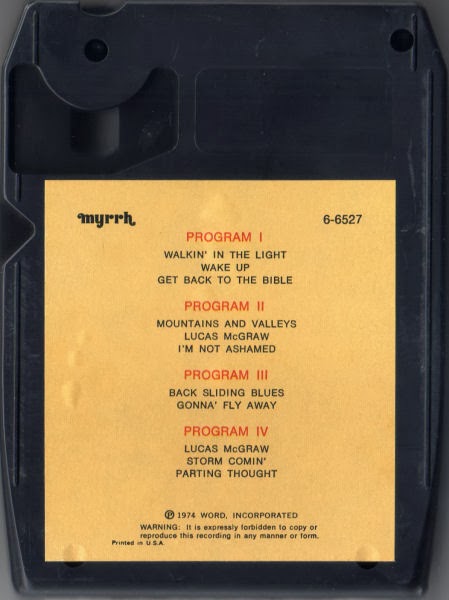


Lucas McGraw was something of a cult classic. People either loved it or hated it. Musically, it was a severe departure from the rest of the album – a bluegrass tune complete with mandolins and banjos. The song ends with what sounds like a pig being shot by a gun. Pig sound effects would not be used this effectively again until Gary S. Paxton’s There Goes a Cigar Smoking a Man. (wink, wink)


Wake Up featured a funky time signature and a blistering guitar solo.

Closing side one was the standout Backslidin’ Blues. This song may have been the first full-on blues tune ever recorded on a major Christian album. The song was a concert favorite back in the day and benefitted from its inclusion on Jubilation, a 2-album various artists compilation that Myrrh Records released in 1975. The song sounds like it was recorded live in some old smoky blues bar, complete with a handful of exuberant ‘regulars’ on hand to cheer on the band. Yes, you can actually hear the clapping, hootin’ and hollerin’ while Hartman and Hough deliver some authentic blues licks and sing about the struggle a Christian can sometimes experience in his quest to stay close to the Lord.

Side two kicks off with Get Back to the Bible (three years before Chris Christian wrote and recorded a song with the same title). This one calls out Hare Krishna and the devil himself while proclaiming that “Jesus is the answer to everything you need to know.”


A&M Release - SP-5061

The second coming of Jesus was the inspiration for Gonna Fly Away. Reminiscent of the old hymn I’ll Fly Away or Servant’s Fly Away, the song contains dual guitar solos and some really funny lines:

Every day I’ve been lookin’ in the sky / Hope it’s not raining when I start to fly
I bet you think I’m strange / Just wait until I’m changed

Where you gonna be when the trumpet blows?
All that’s left of me is gonna be my clothes
I’d really like to see / you flyin’ next to me


Next up is a song that served as a good, overall statement of faith. I’m Not Ashamed has an Allman Brothers feel to it, and more “harmony guitar” technique. It had a nice psychedelic ‘70s ending, employing reverb and feedback (a la Larry Norman). 

Storm Comin’ contained more sound effects (thunder and rain) and even more dual harmony guitar parts.


Finally, Parting Thought was a simple, acoustic tune that invited the listener to once again consider the claims of Christ:

Here’s a song sung with you in mind
Maybe it will make you
Think about Him one more time
And if you can, please try to understand
Jesus is yours for the asking


Parting Thought was included on the 1974 Myrrh compilation album titled Love Peace Joy, exposing the band to a wider audience.


Overall, the band’s debut recording is pretty raw, lacking the refined production values of their future releases. The entire thing was recorded on a $1,000 budget during the span of two weeks. And yet it still brings a smile to the faces of Petra fans as they remember a simpler time, simple lyrics, atrocious vocals…and some smokin’ hot guitar work.


Hough, DeGroff & Glover still tour and record as GHF


The lineup would soon change, as would the sound. But the world had not heard the last of this band of Midwestern Jesus Rock pioneers -- to say the least.


Saturday, March 1, 2014

#93 SONGS FROM THE SAVIOR, VOLUME ONE by Paul Clark (1972)

SONGS FROM THE SAVIOR, VOLUME ONE by Paul Clark
Creative Sound (CSS-1568)

I had the privilege of meeting Paul Clark when my church hosted him on a Sunday morning sometime around 2005. My brother and I took in his concert the night before at the “legendary” Pavilion Coffee House (now sadly defunct) just outside Columbia, South Carolina. We drove Paul from Columbia to Greenville that night and had a wonderful opportunity to visit with this kind, personable, talented, gentle giant from the foundational days of the Jesus Movement. Paul had flown into the Carolinas, so we served as his chauffeurs for a few days, driving him to the church, to the restaurant, to the hotel, to the airport...all the while enjoying discussions on music, faith, and life in general. 


Born in Kansas City, Paul Clark grew up in a close family. He initially was drawn to the jazz records in his parents’ collection. But like many others his age, Paul was ultimately inspired to play music by four mop-topped lads from Liverpool, England. "I had witnessed the ‘fab four’ on the Ed Sullivan Show. They were so vibrant and joyful. I thought to myself, ‘I want to be happy...so, that's what I want to do.’ I purchased a Black Oyster Pearl Ludwig drum set like Ringo's and started a band with a couple of friends called the Kommotions."


Paul (on the drums) and Bill Speer with "The Kommotions"


Unfortunately, the name of that early band proved prophetic. Paul’s life eventually became a whirlpool of drugs and social rebellion. In April of 1970, Paul moved from Kansas to a primitive log cabin at 9,800 feet on the Continental Divide, in the Colorado Rocky Mountains to become an “unlicensed pharmaceutical representative” (he says with a smile). There, his life took a miraculous turn. 


Paul remembers: "On the front porch where I met the Lord, as well as where I penned many of the first songs that I composed about my new faith in Jesus Christ."


This is the cabin Paul Clark was living in when he came to know the Lord in May of 1970. Located off the switch back Hwy. 40 route at the base of Berthoud Pass, Colorado, it is still intact today. Paul says that when he is in that part of Colorado, he always stops by to check it out. "The smell in the air and the sound of the creek that runs next to the cabin immediately take me back to my first love," Paul says.


"I was an 18-year old hippie, strong and independent, yet riddled with fear and hopelessness. Like so many disgruntled youth during the era of Vietnam and social unrest, I tried to find solace in God. An anemic denominational church experience, transcendental meditation, the Bhagavad Gita, the Tibetan Book of the Dead, grass, hash, opium, speed and countless LSD trips left me empty. One day, at the Post Office, I received a box of books from my grandmother about Jesus Christ. I chose one and read it from cover to cover in one day. At the end of the book, I prayed a prayer to follow Jesus as his disciple. The next morning, I remember waking up and sitting on my porch. Something had drastically changed. I felt deeply loved, so new, so clean, so forgiven and unspeakably peaceful. I was also overwhelmed with thankfulness. Concurrently, songs began to pour out of me like the water in the river next to my cabin."


In the eight days following his dramatic conversion, he wrote all of the songs that would eventually comprise his first album, Songs from the Savior Volume One. The title of the project represented Paul’s belief that the songs were literally given to him by Jesus. He started singing these new songs at the Narrow Gate Coffeehouse, a place he and his friends established to reach out to hippies shortly after his move to Denver in 1971. In a recent interview, Paul remembered, “We were leading dozens of people to Christ every day. There was an incredible outpouring of the Holy Spirit back then.” Paul tells the story that a 65-year old man came into the Narrow Gate one day and asked if he had any recordings of his songs. Paul told him no, and the man wrote him a check for $3,000 to get the songs recorded. He was able to track the songs and get 1,000 albums pressed, 247 of which he sold the first night they were made available at the coffee house. 


Recorded in 1971 and released in March of 1972, Songs from the Savior Volume One is nowhere near Paul’s best work as a singer or musician. But it is included on this list because of its historical significance. It was one of Jesus Music’s very first offerings and is credited with helping to establish the genre as an art form. It contains mostly ballads with light acoustic instrumentation. Historian David Di Sabatino says it effectively captures “the emotional spirituality of the revival.” The album is musically mellow, relying heavily on Paul’s acoustic guitar. Lyrically, it is saturated with the simple Good News of Jesus Christ. Looking Glass Incident was biographical: 


I gazed into a looking glass and what did I see?
A face that looked somewhat like mine was staring back at me
His voice was soft and easy and before He left He said
I’d like to save your life before you’re dead 
I begged him not to hurry but He drifted out of sight
His face, it was replaced by a bright and shining light
And then I saw the answer written plainly on my wall
Teach this to your friends before they fall
We could learn to teach our hearts to be free
Just come by faith, be not afraid
For your ticket has been paid
By a man named Jesus Christ from Galilee 


Paul says that Song for Salvation was the first song he ever wrote on piano. He wrote it because he needed a way to lead people at the Narrow Gate Coffeehouse in a prayer to receive Christ, and he thought that a song would be a good way to do it.


Jesus, come in me
Although I’m not worthy to sit at your table
Thank You for making me able to be
A part of Your body
That moves so freely in a world so confusing
That some are losing
What they came here for
To find Your door 
I remember long ago
I didn’t even know that You had died for me
Just to set me free from the world of sin
You know that’s where I’ve been in my life until now
So I’ll take a bow
My knee shall bow and surrender to You 
Please teach me how to pray
‘Cause I don’t know what to say
Make me humble and meek
Make me strong when I am weak
Oh, Spirit intercede
I pray You’ll meet my need
Take away all of my pride and let me abide
In the arms of Your loving grace 

Amen 


The record closed with It Was True, a stirring ballad sung from the perspective of one left behind at Christ’s return. One reviewer noted that “Clark’s vocals have an appealing fragile quality that’s well suited not only to his delicate songs but also to the more dynamic selections wherein comparisons to Van Morrison are not out of line.” All in all, Songs from the Savior Volume One helped to strengthen many new believers in the early 70s.


 Paul released Songs from the Savior Volume Two later that same year. The two records sounded as though they truly were meant to be released together. They combined to create a memorable debut from one of the most important and influential artists of the Jesus Music era. 


Paul Clark today

Paul Clark went on to many bigger and better things, fully exploring rock and jazz in years to come (watch this countdown for more Clark albums).  He has completed 18 solo recording projects, written over 500 songs, produced records for other artists, served as a worship leader/pastor, and has been a published photographer and author.  


Paul’s priorities are clear: "I am mindful that first and foremost, I stand before an audience of One. I seek to pattern my calling to the model that Jesus demonstrated. I hunger to be led by the Holy Spirit. I feel blessed beyond words to have seen and experienced all that I have. I'm humbled that Jesus is still calling me to serve Him. Without a doubt, God uses broken vessels. I intend to keep my hand to the plow spreading the gospel of Jesus Christ. By His grace, I honor the past, embrace the present, and possess a living hope for the future.”


Tuesday, February 25, 2014

#94 MY FATHER'S EYES by Amy Grant (1979)

MY FATHER'S EYES by Amy Grant
Myrrh Records (MSB-6625)
Amy Grant.

That name means different things to different people. For many, she’s the fresh-faced teenager that introduced them to Christian music in the 70s. To others, she’s the queen of ‘80s CCM, prancing back and forth, barefoot in that leopard print jacket on the Grammy Awards telecast, giving new legitimacy to Christian rock. To some, she’s been a lightning rod for controversy, from comments about nude sunbathing in Rolling Stone magazine to an all-too-quick marriage following her divorce from Gary Chapman. Still others see her as a woman who was born to sing Christmas music (she has released three – count ‘em – three amazing holiday albums). At the end of the day, objective observers agree that she has built a long, successful career on music that matters.

Ever since she burst on the scene as a bashful teenager, bringing contemporary Christian music to the forefront of American culture, the Nashville native gained a reputation for creating potent songs that examined life’s complexities with an open heart and keen eye. She went on to become a crossover sensation, her musical gifts transcending genre boundaries to make her a household name.


The numbers are simply staggering:

Over 30 million albums sold worldwide

1 Quintuple Platinum album

1 Triple Platinum

1 Double Platinum album

4 Platinum albums

6 Gold albums

6 Grammy Awards

26 Dove Awards

6 #1 radio singles

She was inducted into the Gospel Music Association Hall of Fame in 2003, and in 2006 she received a star on the Hollywood Walk of Fame.

Born November 25, 1960, in Augusta, GA, where her father, Dr. Burton Paine Grant, was doing his residency, Amy Lee Grant was a descendant of one of the most prominent and prosperous families of Nashville, TN. Her great-grandfather, Andrew Mizell Burton, was a wealthy insurance executive and philanthropist. She was the fourth and final daughter born to her father and her mother, Gloria Grant, following her sisters Mimi, Kathy, and Carol. In addition to being well established socially and financially, the Grant family was also deeply religious. Although she was baptized in the Church of Christ, she soon followed her sister Mimi in attending a breakaway variant of the faith, the Belmont Church of Christ, which took a less formal approach, more in keeping with the Charismatic Movement.

While in the seventh grade at the private Ensworth Grammar School, Amy learned to play the guitar. Later, at the private girls’ prep school Harpeth Hall, Grant began performing with her guitar at devotional meetings at the school, playing songs by such favorites as James Taylor, Carole King, and John Denver. None of them, however, sang Christian songs, so Grant augmented her program with her own faith-based compositions. While working as an intern at a recording studio, she made a tape of her songs for her parents that was heard by producer Brown Bannister, who in turn played it for singer Chris Christian, recently retained by gospel label Word Records as a talent scout. He played it over the phone for label executives, and she was offered a recording contract five weeks before her 16th birthday.

She recorded her first album, simply titled Amy Grant in 1977. It initially sold 250,000 copies, eventually selling over a million copies.


In the fall of 1978, she performed her first ticketed concert—in Fort Worth, Texas—after beginning her first year at Furman University. Grant attended Furman in 1979 and 1980. There she performed one of her earliest paid, professional concerts, opening for Gene Cotton at McAlister Auditorium on the Furman campus. I mention this only because I live 5 miles from the Furman campus and actually saw my first Amy Grant concert in that same McAlister Auditorium several years later (the Age to Age Tour as I recall). She had Kathy Troccoli and some piano player opening for her that night – some guy named Michael W. Smith. I remember the show well because Smith had laryngitis and was unable to sing that night, which was a big disappointment. But I digress.

My Father’s Eyes, Amy Grant’s second album, was released in April of 1979 and demonstrated that the 18-year old singer/college student had grown up a lot in just 2 years. Grant, who wrote or co-wrote eight of the 13 songs, came across as a girl who had seen much more of the world.

The ballad My Father’s Eyes had been written by a young Texan by the name of Gary Chapman, an aspiring Christian songwriter, and it carried a subtle Christian message rather than the sort of overt statement typical of most Gospel music at that time. The message was positive, and it alluded to elements of Christian belief, but it also could be interpreted as a song from a girl to her earthly father. It turned out to be a big radio hit. Another successful radio single was Faith Walking People, with its Chicago-style horn parts. Always the Winner pulled the curtain back to reveal a vulnerable side of Amy, a quality that her legion of admirers would fully embrace in coming years.


Always the winner, baby
You're always the center, baby
But don't ever get lonely at night
When the crowds have gone away?


There was a time when you cared for their hearts
And the need to show them love was tearing you apart
But you're changing, you know
Become the star of the show
Now you've got nothing to give
Where is the truth you once lived?
You're just lonely / Don't you feel lonely?
Turn out the spotlight, I'm tired.
Not my will, but Thine Lord, I'm crying
Oh, won't you turn my gaze back, Lord, to you?
You're the only One who knows me
Please mold me back to You


Always the Winner was also notable for another reason: the instrumentation included synthesized drums (known as “Syndrums” back in the day). Yeah, baby!

The song Bridegroom was written by Marty McCall who would later form the band Fireworks. For some reason, the song featured “fife & drum” accompaniment.


You Were There (written by Stephanie Boosahda) is given a disco treatment, while Amy’s sisters join her for an a cappella rendition of the classic hymn O Sacred Head. [The latter may have been a nod to the church music of her youth. Amy’s family belonged to the Church of Christ denomination, which banned the playing of musical instruments at its services; worshipers sang the hymns a cappella.]

Amy, who was attending college during the week and playing concerts on the weekends, also confessed to spiritual and physical exhaustion in All That I Need Is You:


Lord, you know it's been a busy day / And I'm just weary to my bones
I hope you'll understand if I don't pray / But I need my rest to carry on


Why do I kid myself? You see my heart / The me I try so to ignore
And Lord, You see how very weak I am / I just can't hide it anymore
 
Fairytale offers an interesting take on Good vs. Evil/Jesus vs. Satan. The message is reminiscent of Prince Song by the 2ndChapter of Acts. It’s one of my favorite Amy songs from any of her albums.

I was just like Peter Pan in Never-Never Land
Afraid of what the future might be
Afraid to face the things I couldn't understand
Afraid of things that I couldn't see


Fairytale / It seems just like a fairytale
But there's something in my heart that says this time the story's real
Fairytale / Extraordinary tale
Of a King who offers love so far beyond what I can fee.


There's a world out there that human eyes can never see
But it's just within the reach of the heart
Two princes wage the battle for eternity
But the Victor has been known from the start


Now I can see / The truth can seem so much like a fantasy
But make-believe was never as real to me / I know this time the story's true


Just like Sleeping Beauty in a Neverland / I was dying under a spell
But then a Prince who comes from a Foreverland / Awakened me from my fairytale


From there, the rest of the album gets a little weird. Giggle is about standing up for the Lord (even in the face of being taught evolution in school), which is great…but the musical treatment makes it sound like a children’s song from some PBS kids’ show. Then Brown Bannister takes a prominent vocal role on a duet with Amy called There Will Never Be Another. It comes across like a straight love song; but a closer listen reveals that it’s a song to God, not an earthly lover. The album ends with something that just seems like filler material – an a cappella sing-along called Keep It On Going.

On My Father’s Eyes, Amy Grant and her producer Brown Bannister continued a trend begun by Chris Christian (on his own self-titled debut in 1977 and B.J. Thomas’ Home Where I Belong: to record songs that could be interpreted as either Christian or secular. [This was later referred to as the “God as my girlfriend” syndrome.] Grant and Bannister were forging a new style of Christian pop music here and succeeded wildly.

My Father’s Eyes would eventually be certified a gold record. It also earned Amy her first Grammy nomination.


In May 1979, while at the My Father’s Eyes album release party, Amy Grant met Gary Chapman, writer of the title track (and future husband). Grant & Chapman toured together the summer of 1979. She subsequently left Furman University and returned to Nashville to be closer to the record industry…and to Chapman. Gary and Amy were married on June 19, 1982. Their marriage produced three children.


Sadly, the marriage did not last. Gary Chapman has said that he believes a relationship between Amy and country artist Vince Gill was the primary cause of the divorce. About the breakup, Chapman had this to say to Today’s Christian Music in 2001: “It was not God’s will that we divorced. It wasn’t. That was not His plan. Can He take what has happened and through His miracle of grace do great things for me and for her and for everybody else involved? Yes. And He is. But that doesn’t make it right. It doesn’t. It will never make it right. ‘Irreconcilable differences’ is such a lame and hollow phrase. From my vantage point, we had one irreconcilable difference. I wanted her to stay, and she wanted to leave. Everything else, God could have reconciled."

Divorce has become so common among CCM artists – sometimes multiple divorces. Larry Norman, Randy Stonehill, Steve Archer, Kenny Marks, John Michael Talbot, Bob Bennett, Paul Clark, Pam Mark Hall, Gene Eugene, Derri Daugherty, Mike Roe, Wayne Watson, Greg X. Volz, and on and on we could go. In the interest of full disclosure, I went through one myself in the early 90s. Thank God for Bob Bennett’s Songs From Bright Avenue. That record pretty much kept me sane during a heartbreaking chapter in my life. But the Chapman-Grant split is the most infamous of them all. The timing of it all was troubling, and the differing accounts given in magazine interviews did little to clear things up. Not that any of us are owed an explanation. On the other hand, “When someone has been given much, much will be required in return; and when someone has been entrusted with much, even more will be required.” (Luke 12:48)


A few years after My Father’s Eyes, Amy Grant released a record called Age to Age and never looked back. In the‘80s she would become the undisputed Queen of Christian Pop. She charted new territory. And she sold a heck of a lot of records. She ended up being an ambassador for Christ to more non-Christians than any other Christian artist has ever had the chance to sing to. And that’s a good thing.


Fun Fact: Marty McCall (Fireworks), Steve Chapman(Dogwood) and Lenny LeBlanc all sang background vocals on this album.